







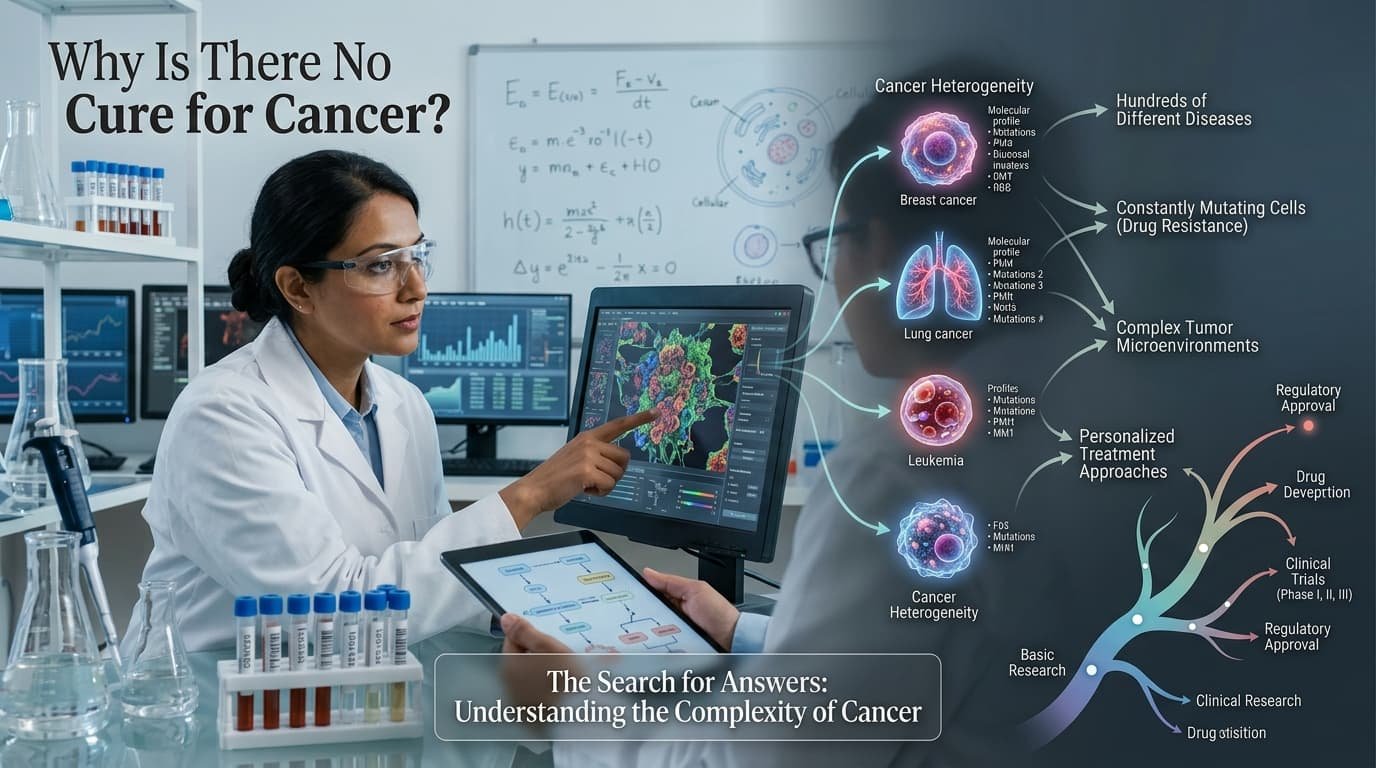
Every year, nearly 10 million people worldwide lose their lives to cancer. Yet despite decades of research, billions in funding, and some of the most brilliant scientific minds on the planet working on the problem, a universal cure still does not exist.
It is one of the most searched questions on the internet: Why is there no cure for cancer?
The honest answer is not a simple one. It is not because scientists are not trying hard enough. It is not because the cure is being suppressed. The real reason is that cancer is one of the most biologically complex and stubbornly adaptive challenges medicine has ever faced.
This article breaks down exactly why, in plain language, backed by the latest science.
Cancer Is Not One Disease – It Is Over 200
The biggest misconception most people carry is that cancer is a single illness with a single solution. Cancer is actually an umbrella term for more than 200 distinct diseases, each arising in different tissues, driven by different genetic mutations, and behaving in completely different ways.
Breast cancer and lung cancer share the word “cancer”, but at the molecular level, they are as different as a cold and a broken leg. A drug designed to target one type may do nothing to another. This is the first and most fundamental barrier to a universal cure.
| Cancer Type | Key Mutation | First-Line Treatment |
| Breast Cancer (HER2+) | HER2 gene amplification | Targeted therapy (trastuzumab) |
| Lung Cancer (NSCLC) | EGFR mutation | Targeted therapy (osimertinib) |
| Leukemia (CML) | BCR-ABL fusion gene | Imatinib |
| Pancreatic Cancer | KRAS mutation | Chemotherapy (gemcitabine) |
| Melanoma | BRAF V600E | Immunotherapy + BRAF inhibitors |
Each cancer requires its own research track, its own clinical trials, and often its own combination of treatments.
Cancer Starts in Your Own Cells, And That Changes Everything
Unlike bacterial infections or viral diseases, cancer does not come from outside the body. Mutations in normal cells cause them to grow uncontrollably, ignoring the body’s signals that regulate growth. Because cancer cells are derived from the body’s own cells, treatments face a uniquely difficult challenge: destroy the cancer without destroying the patient.
This is why chemotherapy causes hair loss, fatigue, and nausea: it attacks fast-dividing cells, which include both cancer cells and healthy ones like those in hair follicles or the gut lining. The margin between a lethal dose for cancer and a lethal dose for the patient is uncomfortably thin.
What Is Tumor Heterogeneity – And Why Does It Ruin Everything?
Even within a single tumor, not all cancer cells are identical. This is called tumor heterogeneity, and it is one of the most important reasons treatments fail.
Tumor heterogeneity is one of the hallmarks of cancer and a core challenge in oncology, and it is the main cause of drug resistance, leading to therapeutic failure.
Think of a tumor as a city with thousands of residents, each with slightly different behaviors. If you design a weapon that kills 90% of the population, the remaining 10% survive, adapt, and rebuild, often in more resistant forms. That is essentially what happens when cancer is treated.
How Heterogeneity Plays Out in Real Treatment:
- A patient responds well to chemotherapy initially
- A small sub-population of cancer cells with a different mutation survives
- Those cells multiply and form a new, drug-resistant tumor
- The same treatment no longer works
Drug Resistance: Cancer’s Most Dangerous Weapon
Drug resistance is directly and fatally linked to tumors; it is not an isolated complication but a core biological process that causes treatment failure and triggers tumor recurrence and metastasis.
Cancer cells resist drugs through several mechanisms:
- Efflux pumps – proteins that literally pump drugs out of the cancer cell before they can do damage
- Target mutations – the protein a drug was designed to attack changes shape, rendering the drug useless
- Alternative signaling pathways – the cancer “reroutes” its survival signals around the blocked pathway
- Immune evasion – cancer suppresses the body’s immune response, so it cannot fight back
This is why a treatment that works beautifully in Year 1 can become completely ineffective by Year 2.
Why Immunotherapy Is Not a Complete Answer (Yet)
Immunotherapy, training the immune system to fight cancer, has been one of the most exciting advances in oncology in decades. Checkpoint inhibitors like pembrolizumab have produced remarkable results in some patients with melanoma and lung cancer.
But immunotherapy is not a cure-all. Primary resistance in immunotherapy frequently occurs in so-called “cold tumors,” characterized by low antigenicity, minimal T-cell infiltration, and an immunosuppressive microenvironment, resulting in poor responsiveness.
In simple terms, some tumors are invisible to the immune system. You cannot train immune cells to attack something they cannot see.
CAR-T cell therapy – where a patient’s own T-cells are genetically engineered to target cancer- has shown extraordinary success in blood cancers like leukemia. But using it to treat solid tumors like lung, colon, or brain cancer remains a major challenge because these cancers vary a lot internally and create an environment that weakens immune responses.
The Metastasis Problem: When Cancer Travels
A significant barrier to curing cancer is metastasis, the process by which cancer cells spread to other parts of the body. When cancer cells detach from their primary tumor, they can enter the bloodstream or lymphatic system.
Once cancer spreads to multiple organs, treatment becomes exponentially more difficult. Surgery can remove one tumor. It cannot remove microscopic cancer cells circulating in the blood.
This is also why early detection saves lives. A localized tumor caught at Stage I has a survival rate that can exceed 90% in some cancers. The same cancer at Stage IV may drop that rate below 20%.
What 2026 Research Is Actually Showing
The good news: science is making real, measurable progress. Personalized “neoantigen” vaccines can train the immune system to recognize unique tumor fingerprints and, in some cases, prevent aggressive cancers from returning.
Here are the most promising areas as of 2026:
1. mRNA Cancer Vaccines
Building on COVID-19 vaccine technology, researchers are developing personalized vaccines that target the unique mutations of each patient’s tumor. A study in Nature found that people with advanced melanoma or lung cancer who received an mRNA vaccine for COVID-19 lived significantly longer than those who did not. Dedicated cancer mRNA vaccines are now in Phase III trials.
2. CRISPR Gene Editing
In May 2025, Intima Biosciences published results from a phase I/II trial using CRISPR-edited tumor-infiltrating immune cells in patients with metastatic colon cancer, with one patient in remission at 21+ months, a promising early proof of concept.
3. Liquid Biopsy
A 2025 study by Johns Hopkins found that liquid biopsy could detect cancer relapse 7-8 months before conventional scans. This simple blood test could revolutionize early detection globally.
4. AI-Assisted Diagnosis
An AI model from the Harvard-MIT Broad Institute can detect 14 different cancer types in their earliest stages using liquid biopsy, with accuracy reaching up to 92% in several cases.
The Difference Between Remission and a Cure
Many people hear that a cancer patient is “cancer-free” and assume they are cured. The distinction matters enormously.
A cure means treatment has eliminated all traces of cancer from the body and ensured it will not come back. Remission, on the other hand, means few to no signs of cancer are detectable, but the risk of recurrence remains.
Doctors generally consider a patient “cured” only after five or more years without recurrence, and even then, some cancers can return decades later.
Why One Universal Cure Is Unlikely to Ever Exist
To put it plainly: asking for a single cure for cancer is like asking for a single cure for all infections. We don’t have one antibiotic that treats every bacterial disease. We won’t have one drug that treats every cancer.
What science IS moving toward is a future where:
- Every cancer is caught earlier (liquid biopsy, AI screening)
- Every treatment is personalized to the patient’s specific tumor genetics
- Immunotherapy is made smarter and more targeted
- Combination therapies prevent resistance from developing
Emerging technologies, including artificial intelligence and liquid biopsy, are driving progress across the entire cancer care continuum, from early detection to treatment selection and disease monitoring.
Frequently Asked Questions
Will we ever cure cancer?
Scientists believe we will not find one universal cure, but we are moving toward personalized treatments that can effectively manage or eliminate most cancer types in the coming decades.
Why has cancer research taken so long?
Cancer involves hundreds of different diseases, each requiring separate research, clinical trials, and regulatory approval, a process that typically takes 10–15 years per treatment.
Is there any cancer that has been cured?
Some cancers, like certain types of leukemia, testicular cancer, and early-stage thyroid cancer, have very high cure rates with current treatments.
Is Big Pharma hiding a cancer cure?
No credible evidence supports this claim. Cancer is so diverse and complex that no single suppressed cure could exist, and thousands of independent researchers worldwide are actively working on the problem.
What is the most promising cancer treatment in 2025?
Personalized mRNA cancer vaccines, CRISPR-based gene editing, CAR-T cell therapy, and AI-powered liquid biopsies are among the most exciting advances currently in clinical trials.
Can cancer come back after being cured?
Yes. Cancer recurrence happens because microscopic cells can survive treatment and re-emerge, sometimes years later. This is why long-term monitoring after remission is essential.
Conclusion: Not Hopeless – Just Genuinely Hard
The reason there is no cure for cancer is not a failure of science or will. It is a reflection of how extraordinarily complex biology truly is. Cancer evolves, adapts, hides, and fights back in ways that continue to challenge even the most advanced medical systems on earth.
But the trajectory is clear. Overall, cancer survival in the UK has doubled since the 1970s, and similar trends are visible worldwide. The tools of 2026, AI, liquid biopsy, gene editing, and personalized vaccines, are genuinely different from anything that came before.
We may never have a single cure. But we are building something better: a future where a cancer diagnosis is no longer a death sentence, but a problem that medicine is increasingly equipped to solve, one patient, one tumor, one breakthrough at a time.