








If your doctor has recommended a temple scan, you’re probably wondering what it is, why it matters, and what happens during the procedure. Temple scans, most commonly, temporal artery ultrasounds or biopsies, are powerful diagnostic tools used to examine the blood vessels and structures near your temples. In 2026, these scans play a growing role in diagnosing serious conditions like giant cell arteritis (GCA) before they lead to permanent complications like blindness or stroke.
What Are Temple Scans?
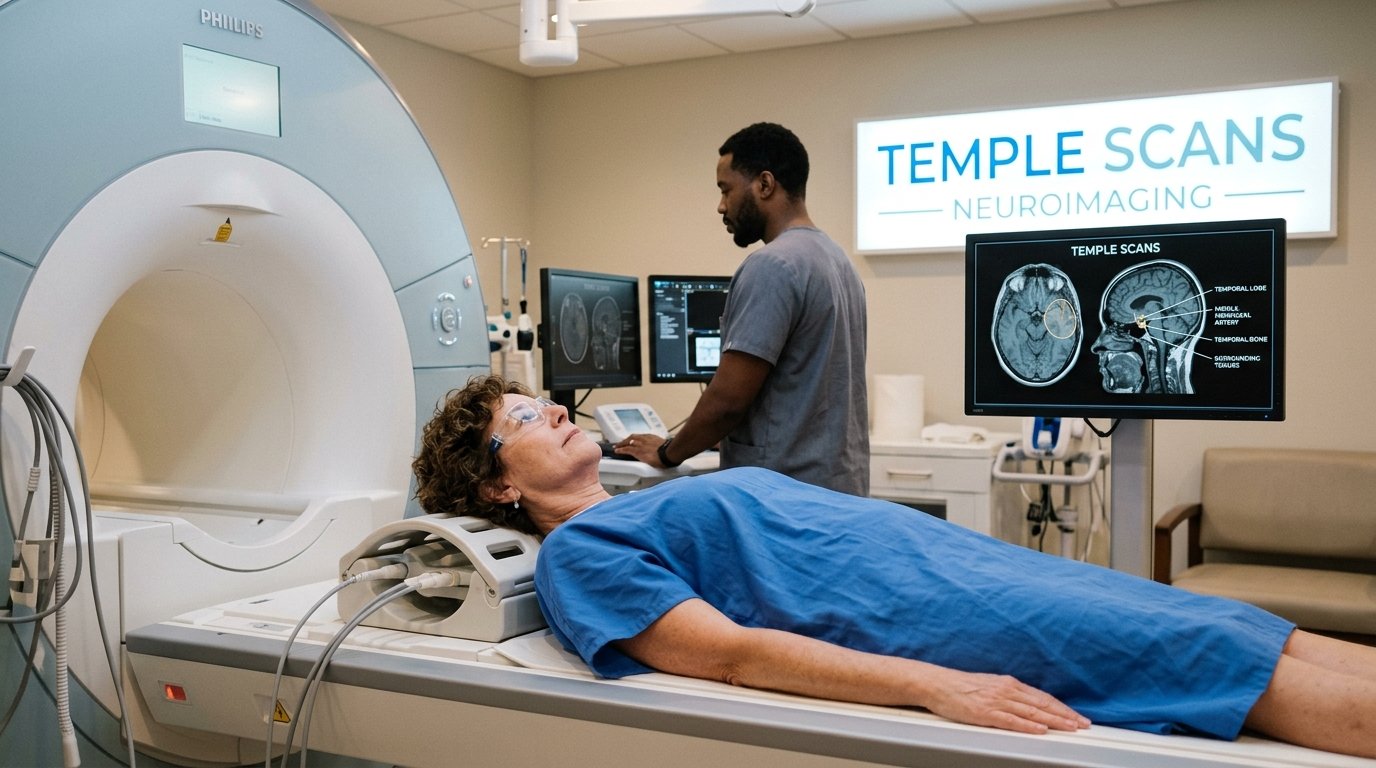
A temple scan is a diagnostic imaging or biopsy procedure that examines the temporal region of the head, the area around your temples, to assess blood vessels, surrounding tissues, nerves, and nearby brain structures. The two most common types are temporal artery ultrasound (TAUS) and temporal artery biopsy (TAB).
The temporal arteries are blood vessels located on either side of the head. They run along the temples, supplying blood to the scalp, face, and parts of the brain. When these arteries become inflamed or blocked, the consequences can be severe.
Quick Answer: A temple scan examines the temporal arteries and surrounding structures to diagnose conditions like giant cell arteritis (GCA), vascular inflammation, tumors, and trauma. The procedure is usually painless, non-invasive, and takes 15–30 minutes.
Types of Temple Scans
There are two main methods doctors use to scan the temporal region:
| Type | Method | Invasive? | Best For |
| Temporal Artery Ultrasound (TAUS) | Sound waves via a Doppler probe | No | Initial GCA screening, inflammation |
| Temporal Artery Biopsy (TAB) | A small tissue sample was removed | Yes (minor) | Confirming the GCA diagnosis histologically |
| CT Scan of Temporal Region | X-ray cross-sections | No | Tumors, trauma, and bone issues |
| MRI of Temporal Structures | Magnetic fields + radio waves | No | Soft tissue detail, nerve involvement |
History and Evolution of Temple Scans
Temple scanning has evolved dramatically over the past five decades. In the 1970s and 80s, temporal artery biopsy was the only reliable way to confirm vascular inflammation near the temples. By the 1990s and 2000s, color Doppler ultrasound emerged as a faster, non-invasive alternative.
A major milestone came when Wolfgang Schmidt, MD, first described the “halo sign”, a dark ring visible around inflamed temporal arteries on ultrasound, which gave clinicians a reliable non-surgical marker for diagnosis. By 2025, the European League Against Rheumatism (EULAR) updated its guidelines to recommend temporal artery ultrasound as the first-line imaging approach in suspected GCA cases, reflecting a significant shift in clinical practice.
How Do Temple Scans Work? Step-by-Step
The process depends on which type of scan your doctor orders. Here is how the most common one, temporal artery ultrasound, works:
- Preparation: You lie on an examination table. No fasting or special preparation is needed in most cases.
- Gel application: The radiologist applies a water-based gel to the skin around your temples to help transmit sound waves.
- Probe placement: A small handheld ultrasound probe (usually a high-frequency, 15–18 MHz linear transducer) is gently moved over the temple area.
- Doppler imaging: The probe uses Doppler technology to measure blood flow velocity and detect any narrowing, blockages, or inflammation in the artery walls.
- Halo sign assessment: The radiologist looks for a characteristic dark ring (halo) around the artery, a key indicator of inflammation consistent with giant cell arteritis.
- Results: The radiologist documents findings and shares a report with your referring doctor, usually within 24-48 hours.
The entire scan typically takes 15 to 30 minutes and involves no radiation.
What Conditions Do Temple Scans Diagnose?
Temple scans are recommended for a range of vascular, neurological, and inflammatory conditions, including:
- Giant cell arteritis (GCA) – the most common reason; a granulomatous vasculitis affecting large and medium arteries, most common in people over 50
- Temporal arteritis – inflammation of the temporal arteries that can cause headaches, jaw pain, and vision loss
- Polymyalgia rheumatica (PMR)– frequently coexists with GCA
- Vascular tumors or lesions near the temple region
- Head trauma assessment – evaluating injury to superficial vessels
- Autoimmune flare monitoring – in patients with rheumatoid arthritis or lupus
When Do Doctors Recommend a Temple Scan?
Your doctor may refer you for a temple scan if you experience one or more of the following symptoms:
- New, persistent headaches centered around the temples
- Scalp tenderness or pain when combing hair
- Jaw pain while chewing (jaw claudication)
- Sudden or progressive vision loss or double vision
- Fever, unexplained fatigue, or unintentional weight loss
- Elevated inflammatory markers, ESR or CRP, on blood tests
- Known or suspected autoimmune condition
GCA is considered a medical emergency because untreated inflammation can cut off blood supply to the optic nerve, causing permanent blindness. Early scanning and prompt treatment are critical.
Key Benefits of Temple Scans
Temple scans, especially temporal artery ultrasound, offer several important clinical and patient benefits:
- Non-invasive and painless – no needles, no incisions, no radiation
- Fast results – imaging can be completed in under 30 minutes
- High diagnostic accuracy – studies show temporal artery ultrasound has strong sensitivity for detecting the halo sign in GCA
- Cost-effective – significantly cheaper than proceeding directly to surgical biopsy
- Real-time assessment – Doppler technology shows live blood flow patterns
- Guides treatment planning – findings directly inform corticosteroid therapy decisions
- Monitors disease progression – useful for follow-up after treatment begins

Temple Scan vs. Temporal Artery Biopsy: Which Is Better?
This has been a significant clinical debate in 2025 and 2026. At the ACR Convergence 2025 session, two vasculitis experts debated whether ultrasound or biopsy should be the first test in diagnosing GCA. Here is how the two approaches compare:
| Factor | Ultrasound (TAUS) | Biopsy (TAB) |
| Invasiveness | None | Minor surgical procedure |
| Speed | 15–30 minutes | Days (lab analysis needed) |
| Accuracy | High (halo sign specific) | Gold standard histologically |
| Patient comfort | Painless | Local anesthesia needed |
| Cost | Lower | Higher |
| Availability | Widely available | Requires a surgical team |
| EULAR 2025 guidance | Preferred first-line | Used when the ultrasound is inconclusive |
The European guidelines now favor ultrasound as the initial imaging modality, while the American ACR/VF guidelines have maintained a role for biopsy, reflecting differing clinical contexts globally.
How to Prepare for a Temple Scan
Preparation is simple. Follow these practical steps before your appointment:
- Do not apply creams, lotions, or makeup to the face or temple area on the day of the scan
- Stay well-hydrated, good hydration improves vascular visibility on ultrasound
- Bring any previous test results, especially blood work showing ESR or CRP levels
- Inform the radiologist of any known allergies (e.g., to gel materials)
- Wear comfortable, loose clothing around the neck and head area
- If you take corticosteroids, tell your doctor that treatment can alter ultrasound findings
Risks and Limitations of Temple Scans
Temporal artery ultrasound carries virtually no risks; it uses no radiation, no contrast injection, and involves no skin penetration. For temporal artery biopsy, there are minor surgical risks including localized bruising, scarring, and rare infection at the biopsy site.
Important limitations to be aware of:
- Ultrasound results can be affected by operator experience, quality varies between centers
- Starting corticosteroid treatment before the scan can reduce halo visibility within days
- A negative ultrasound does not completely rule out GCA; a biopsy may still be needed
- Biopsy samples must be long enough (ideally 15mm+) to avoid false negatives due to “skip lesions.”
Controversies Surrounding Temple Scans
The primary controversy in 2025-2026 centers on whether temporal artery ultrasound can replace biopsy entirely as the diagnostic gold standard. Temporal artery biopsy has long been the gold standard for GCA diagnosis, but with continued advancements in ultrasound resolution and growing provider expertise, temporal artery ultrasound is increasingly being used in practice.
Some clinicians argue that histological confirmation via biopsy remains essential for definitive diagnosis and medico-legal documentation. Others counter that ultrasound is faster, cheaper, and avoids surgical risk, making it more patient-friendly and clinically efficient. The debate reflects an ongoing evolution in evidence-based rheumatology practice.
The Future of Temple Scans in Healthcare (2026 and Beyond)
The field is advancing rapidly. Key developments to watch include:
- AI-assisted ultrasound interpretation – machine learning algorithms are being trained to identify the halo sign automatically, reducing operator dependency
- Portable point-of-care ultrasound – handheld devices allow emergency department clinicians to scan for GCA bedside without waiting for radiology.
- PET/CT integration – for assessing large-vessel involvement beyond the temporal region
- Optical coherence tomography (OCT) – an emerging tool showing promise for non-invasive GCA assessment
- Standardized training programs – EULAR and BMUS are rolling out certification for GCA ultrasound globally to improve consistency of results
Frequently Asked Questions (FAQs)
Q: Is a temple scan painful?
No. Temporal artery ultrasound is completely painless — you only feel the gel and gentle probe pressure. A biopsy uses local anesthesia, so discomfort is minimal.
Q: How long does a temple scan take?
A temporal artery ultrasound typically takes 15 to 30 minutes. You can resume normal activities immediately after.
Q: Do I need a referral for a temple scan?
Yes, in most countries, a doctor’s referral is required. Your GP or specialist will request the scan based on your symptoms.
Q: Can temple scans detect brain tumors?
Temporal ultrasound primarily assesses blood vessels. CT or MRI is more appropriate for detecting brain tumors in the temporal area.
Q: What is the halo sign in a temple scan?
The halo sign is a dark ring visible around an inflamed temporal artery on ultrasound; it is a key diagnostic marker for giant cell arteritis.
Q: Are temple scans covered by insurance?
Most health insurance plans cover temple scans when medically indicated by a physician. Always confirm with your insurer before booking.
Q: How soon should I get a temple scan if GCA is suspected?
As soon as possible, ideally within 24-48 hours of symptom onset, as delayed diagnosis can lead to permanent vision loss.
Q: Is temporal artery ultrasound replacing biopsy?
In many European centers, yes, EULAR 2025 guidelines favor ultrasound first. Biopsy is still used when ultrasound is inconclusive or unavailable.
Conclusion
Temple scans are among the most important diagnostic tools available for detecting vascular inflammation and related conditions affecting the temporal region of the head. Whether performed as a non-invasive ultrasound or a minor biopsy, these procedures provide critical information that can prevent life-changing complications like blindness or stroke.
In 2026, the clinical landscape is shifting toward temporal artery ultrasound as the preferred first-line approach. It is faster, safer, and increasingly accurate. However, biopsy remains the gold standard for histological confirmation. If your doctor recommends a temple scan, do not delay. Early diagnosis and prompt treatment are the best protection against serious long-term harm.
Always consult a qualified healthcare professional for diagnosis and treatment decisions. This article is for informational purposes only.