








Did you spend your childhood being called “too flexible,” “clumsy,” or simply “dramatic” every time you complained about pain? Were your mysterious bruises brushed off, your joint aches labeled as growing pains, and your exhaustion blamed on laziness? If so, you might have been living with Ehlers-Danlos Syndrome long before anyone ever gave it a name.
Ehlers-Danlos Syndrome (EDS) is a group of 13 genetic connective tissue disorders that affect the joints, skin, blood vessels, and internal organs. The condition is caused by faulty collagen, the protein that holds your body’s structures together. When collagen doesn’t work properly, nearly every system in the body can be affected.
The cruel irony? Because EDS is a complicated condition that overlaps with many other chronic illnesses, it’s not uncommon for it to take more than 10 years to get a diagnosis. That means millions of children grow up confused, dismissed, and undiagnosed, collecting symptom after symptom with no unifying explanation.
This article walks through 23 signs that strongly suggest you grew up with EDS, even if no one recognized it at the time.
What Is Ehlers-Danlos Syndrome?
Ehlers-Danlos syndromes are a group of disorders that share common features, including easy bruising, joint hypermobility (loose joints), skin that stretches easily, and weakness of tissues. The condition is genetic, meaning it is passed down through families, though in some cases, a new mutation occurs with no family history.
There are 13 subtypes of EDS, each with its own set of symptoms and severity. The most common is hypermobile EDS (hEDS), followed by classical EDS.
| EDS Type | Key Feature | Inheritance |
| Hypermobile (hEDS) | Joint laxity, chronic pain | Autosomal dominant |
| Classical (cEDS) | Stretchy skin, poor wound healing | Autosomal dominant |
| Vascular (vEDS) | Fragile blood vessels | Autosomal dominant |
| Kyphoscoliotic | Severe scoliosis, eye fragility | Autosomal recessive |
Why EDS Is So Often Missed in Childhood
EDS patients tend to have symptoms and complications across many different bodily systems and are seen by specialists to address these complaints, but these specialists often do not think of a connective tissue disorder, and thus, signs of EDS can be overlooked.
Such features are often present in childhood but may be considered “normal” for the family or attributed to external factors. Parents chalk it up to being an active kid. Doctors call it growing pains. Teachers assume it’s behavioral. The result is a long, exhausting diagnostic odyssey that leaves patients without answers for years.
23 Signs You Grew Up With Ehlers-Danlos Syndrome
1. You Were the “Bendy” Kid
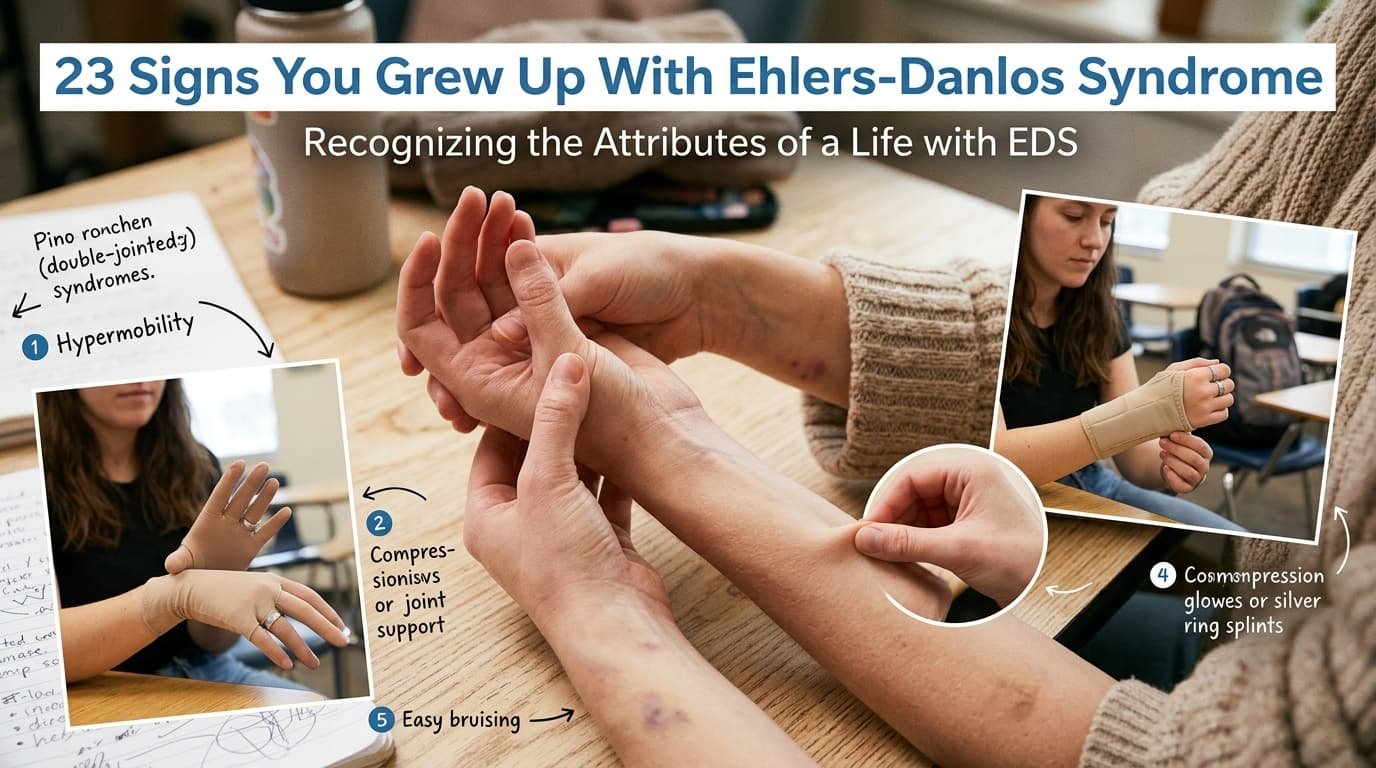
You might have amazed others with your ability to perform “party tricks” with hypermobile joints, like bending your fingers backward or touching your toes to your forehead. This extreme flexibility, called joint hypermobility, is the most recognizable hallmark of hEDS. Clinicians measure it using a tool called the Beighton Score, which tests nine specific joint movements.
2. You Bruise Easily and Constantly
Many people with Ehlers-Danlos syndrome have fragile skin that’s prone to bruising easily, and sometimes you won’t even recognize what caused the bruise. Waking up with unexplained bruises was just a regular Tuesday.
3. Your Skin Felt Unusually Soft or Stretchy
The smooth, velvety skin is fragile and tears or bruises easily with minor trauma in classic EDS. Even in hEDS, the texture of skin often feels noticeably different, softer, more elastic, almost dough-like compared to peers.
4. “Growing Pains” That Never Really Went Away
Doctors told your parents it was growing pains. But real growing pains don’t persist for years, show up in multiple joints, or flare after minor activity. What was actually happening in many cases was joint instability, partial dislocations (subluxations) that went unrecognized.
5. Frequent Joint Dislocations or Sprains
Activities like simple sports or physical tasks sometimes resulted in sprains or dislocated joints, making everyday tasks risky. Ankles would roll on flat ground. Shoulders would slip out while reaching for a glass. These weren’t freak accidents; they were a pattern.
6. Gym Class Was a Nightmare
Joint pain from running, jumping, or even walking fast made gym class a nightmare. You may have found ways to avoid participation or consistently underperformed despite being an otherwise capable kid. This was often misread as laziness or a lack of effort.
7. You Healed Slowly and Scarred Strangely
Poor wound healing and unusual scarring, particularly wide, papery, or “cigarette paper” scars, are a known feature of classical EDS. Even minor cuts seemed to take forever to close and left scars far out of proportion to the injury.
8. Dizziness When Standing Up Quickly
Standing up quickly often led to dizziness or “seeing stars,” a common symptom of POTS (Postural Orthostatic Tachycardia Syndrome) related to EDS. POTS causes the heart rate to spike when moving from lying or sitting to standing, and it frequently co-occurs with EDS.
9. Chronic Fatigue That No One Took Seriously
You weren’t lazy. You were exhausted, genuinely, deeply exhausted in a way that sleep didn’t fix. Chronic fatigue in EDS is driven by multiple factors: poor sleep from pain, the muscular effort of stabilizing hypermobile joints, and autonomic dysfunction affecting energy regulation.
10. Digestive Problems Were Constant
People diagnosed with EDS may experience gastrointestinal issues, including nausea, bloating, constipation, and slow gut motility. This often links to mast cell activation syndrome (MCAS) and autonomic dysfunction, both of which commonly run alongside EDS.
11. Headaches and Migraines Were a Regular Part of Life
Chronic headaches are common in patients with Ehlers-Danlos syndrome, whether related to dysautonomia, temporomandibular joint dysfunction (TMD), muscle tension, tethered cord syndrome, or craniocervical instability. Many EDS children are placed on migraine medications without anyone connecting the dots.
12. Your Joints Clicked and Popped Constantly
Cracking knuckles is one thing. But when every movement, standing, walking, turning your head, produces audible pops, clicks, and grinding sensations, that’s something different. This crepitus results from unstable joint surfaces moving improperly against each other.
13. You Had Terrible Handwriting or Struggled With Grip
If you’re prone to dislocations and experience chronic pain in your hands, it can be painful to learn the same grip as your classmates in grade school. Many EDS kids struggle with pencil grip, scissors, and fine motor tasks, often misdiagnosed with dyspraxia or dismissed entirely.
14. Poor Balance and Coordination Made You “Clumsy.”
EDS affects proprioception, your body’s ability to sense where its joints are in space. When proprioception is faulty, you misjudge distances, trip over nothing, and struggle with coordination. You might need to adapt activities for your body in ways your peers didn’t even think about.
15. Anxiety or Low Mood That Seemed to Come From Nowhere
A 2025 genome-wide association study meta-analysis of hEDS identified genetic correlations with depression, anxiety, and autism spectrum disorder, confirming that EDS is fundamentally a multi-system condition. This isn’t just a reaction to being sick; there appears to be a neurobiological overlap.
16. Scoliosis or Spine Curvature Detected at School
Because the ligaments supporting the spine are lax, the vertebrae can gradually drift into abnormal curves. Many EDS children are diagnosed with scoliosis at school screenings, with no one linking it to connective tissue disease.
17. TMJ Problems – Jaw Clicking, Pain, or Locking
The temporomandibular joint (TMJ) is one of the most frequently hypermobile joints in EDS. Children may experience jaw pain, clicking, difficulty chewing, or the jaw locking open or shut. Dentists and oral surgeons rarely consider EDS as a cause.
18. You Overheated Easily or Sweated More Than Others
Heat or exertion could cause rapid overheating or sweating more than others. Autonomic nervous system dysfunction, which regulates temperature control, heart rate, and blood pressure, is a common under-recognized feature of EDS.
19. Bladder Issues Started Young
Bladder and pelvic floor dysfunction are now recognized as common but frequently overlooked features of EDS, particularly in hypermobile EDS. Weak connective tissue in the pelvic floor contributes to these issues.
20. Allergies, Asthma, or Unexplained Immune Reactions
Mast cell activation syndrome (MCAS), where immune cells overreact and release histamine, clusters strongly with EDS. Children with EDS frequently carry diagnoses of allergies, food sensitivities, eczema, or asthma without anyone identifying the shared underlying mechanism.
21. Sleep Problems Despite Exhaustion
Pain-interrupted sleep, restless legs, difficulty falling asleep, and waking unrefreshed are extremely common in EDS. You were tired all day but couldn’t sleep at night, a pattern that adults dismissed as anxiety or poor sleep hygiene.
22. You Sat in a “W” Position on the Floor
The W-sit, where a child sits with both knees bent outward and feet behind their hips, is common in hypermobile children because it provides more joint stability than normal sitting positions. Many EDS adults recognize this habit from their childhood photos.
23. You Felt Different, But Could Never Explain Why
Looking back, the signs were there, little things that didn’t seem connected at the time. The constant bruises, the fatigue, the pain dismissed as drama, the exhaustion of performing “normal” when your body felt anything but. This invisible struggle, the sense of being different without a name for it, is perhaps the most universal EDS childhood experience of all.
How Many Signs Do You Need to Suspect EDS?
There is no magic number. EDS diagnosis is based on a pattern of symptoms evaluated by a knowledgeable clinician, typically a geneticist or rheumatologist, using the 2017 International EDS Classification Criteria. If several of these signs resonate with you, particularly joint hypermobility alongside skin involvement, chronic pain, and fatigue, it is worth seeking a specialist evaluation.
EDS vs. Similar Conditions: A Quick Comparison
| Condition | Shared Features | Key Difference |
| EDS | Joint laxity, chronic pain, fatigue | Tissue fragility, collagen gene mutations |
| Hypermobility Spectrum Disorder (HSD) | Joint laxity, pain | No connective tissue signs |
| Fibromyalgia | Chronic pain, fatigue | No joint instability or skin features |
| Marfan Syndrome | Joint laxity, tall stature | Cardiovascular involvement, FBN1 gene |
| POTS | Dizziness, fatigue | Autonomic only; frequently co-occurs with EDS |
What Should You Do If These Signs Sound Familiar?
- Document your symptoms. Keep a journal of joint incidents, pain locations, fatigue levels, and any skin or healing oddities. Patterns matter in EDS diagnosis.
- See the right specialist. A geneticist or connective tissue specialist is your best route. Some rheumatologists are also knowledgeable, but not all.
- Ask about comorbidities. If you have EDS, screening for POTS, MCAS, and mast cell activation is worthwhile.
- Connect with the EDS community. The Ehlers-Danlos Society (ehlers-danlos.com) provides updated guidelines, support resources, and a directory of knowledgeable healthcare providers.
- Don’t give up. A 2024 study highlighted ongoing misdiagnosis, with hEDS patients experiencing an average diagnostic odyssey of several years before receiving a correct diagnosis. Persistence pays off.
Frequently Asked Questions (FAQs)
Can EDS be diagnosed in childhood?
Yes. EDS can be diagnosed at any age, including childhood, though it is frequently missed because symptoms are mistaken for normal growing pains or clumsiness.
Is Ehlers-Danlos Syndrome hereditary?
Yes. Most EDS subtypes are inherited genetically, though new (spontaneous) mutations also occur, meaning someone can have EDS without a family history.
What is the most common type of EDS?
Hypermobile EDS (hEDS) is by far the most common subtype, affecting the majority of people diagnosed with the condition.
Does EDS get worse with age?
EDS itself doesn’t typically “progress” like a degenerative disease, but the wear on joints, muscles, and tissues over time can cause symptoms to worsen without proper management.
Is there a cure for Ehlers-Danlos Syndrome?
No. There is currently no cure, but symptoms can be managed effectively through physical therapy, pain management, lifestyle modifications, and treating comorbid conditions like POTS and MCAS.
What does the Beighton Score measure?
The Beighton Score is a 9-point scale used by clinicians to assess joint hypermobility, a primary diagnostic criterion for hEDS.
Can EDS cause mental health issues?
Research confirms a neurobiological link between EDS and conditions like anxiety, depression, and ADHD, not simply a reaction to living with chronic illness, but a genuine systemic overlap.
Conclusion
Growing up with undiagnosed EDS means spending years collecting symptoms that no one connects into a single picture. The “bendy kid” who bruised easily, was always tired, had unexplained gut issues, and couldn’t keep up in gym class, that child wasn’t dramatic or fragile or making it up. They had a real, genetic, systemic condition affecting their collagen.
Recognizing these 23 signs is not a diagnosis. But it is the beginning of asking better questions, and potentially the start of a path toward real answers, proper management, and a community that finally understands what you went through.
If any of this article described your childhood, speak with a connective tissue specialist. You deserve to know.