








What Is Dubolsinho?
If you have ever searched for quality Brazilian children’s books or looked up charming cultural spots in the historic town of Sabará, you have likely come across the name Dubolsinho. But what exactly is it?
Dubolsinho refers to two interconnected things: Edições Dubolsinho, a celebrated Brazilian independent publishing house known for children’s and young adult literature, and Café Dubolsinho, a cozy bookshop-café located in the heart of Sabará, Minas Gerais. Together, they represent a rare blend of literary passion, community spirit, and cultural identity rooted deeply in Brazilian soil.
Dubolsinho is a Brazilian independent publishing house, founded in 2000 and based in Sabará, Minas Gerais, specializing in children’s and young adult literature in Brazilian Portuguese. Over the years, it has grown from a small community project into one of the most respected names in independent Brazilian publishing, a name that carries warmth, creativity, and purpose.
Quick Bio: Dubolsinho at a Glance
| Detail | Information |
| Founded | Year 2000 |
| Founder | Sebastião Nunes (pen name: Sebastião Nuvens) |
| Location | Sabará, Minas Gerais, Brazil |
| Specialty | Children’s & Young Adult Literature |
| Total Titles | ~100+ books |
| Key Project | Lerês, Ler e Escrever por Prazer (2009) |
| Awards | Prêmio Governo de Minas Gerais de Literatura (2018) |
| Current Status | Publishing house closed in 2019; café operated separately |
Founding and Background of Edições Dubolsinho
The story of Dubolsinho begins long before the year 2000. In 1980, Sebastião Nunes launched an earlier venture called Edições Dubolso, where he handled all design and graphic work at no cost to the authors, who only had to pay for printing.
Two decades later, that same spirit evolved into something bigger. In 2000, Sebastião Nunes founded the publisher together with a group of around 40 other authors, illustrators, and cultural collaborators, launching initially with six titles, four of which were his own.
The name itself carries meaning. “Dubolsinho” is an affectionate, smaller version of “Dubolso,” carrying the same spirit of independent, community-driven publishing. In Portuguese, the suffix -inho is a loving diminutive, making the name feel both personal and welcoming to young readers and their families.
Sebastião Nunes is a poet, writer, graphic artist, and editor born in Bocaiúva, northern Minas Gerais. His dedication to education and the arts shaped every decision Dubolsinho made, from the books it chose to publish to the communities it chose to serve.
Who Founded Dubolsinho and When?
Sebastião Nunes (born December 5, 1938) is a Brazilian writer, editor, graphic artist, and poet. In 2000, he founded Editora Dubolsinho with 39 other co-founders, dedicated to publishing children’s and young adult works, launching initially with six titles.
Under the playful pen name Sebastião Nuvens, he began publishing texts for young readers in 1996, inspired by his daughters Teresa and Alice, then aged 10 and 5 years old. This personal motivation gave Dubolsinho its genuine warmth, these were books created by a father who understood what children truly needed to read.
Focus on Children’s and Young Adult Literature
From day one, Dubolsinho’s editorial compass pointed toward young readers. The publisher believed that nurturing a love of reading in childhood was not just good business; it was a responsibility.
Children’s books released by Dubolsinho often combine playful language with deeper life lessons. Stories encourage curiosity, empathy, and creativity without becoming overly didactic.
These publications often integrated local Brazilian folklore, cultural narratives, and moral lessons, which helped instill a sense of cultural identity and ethical understanding in children.
What made Dubolsinho different from larger publishers was its refusal to water down ideas. Instead of simplifying ideas excessively, Dubolsinho trusted children to engage thoughtfully with complex emotions and imaginative concepts.
Artistic and Creative Publishing Style
Dubolsinho never treated a book as just a product. Every title was approached as a complete artistic project.
Illustration plays a vital role in Dubolsinho’s children’s publications. Visual storytelling enhances comprehension and emotional impact. Carefully designed artwork complements the written narrative, creating a cohesive reading experience.
The publisher consistently merged visual art with literary content, reflecting the graphic design roots of its founder. Books were beautiful objects in themselves, inviting not just reading but admiration. This artistic philosophy set Dubolsinho apart from mass-market Brazilian publishers who prioritized volume over quality.
Notable Titles and Authors
Over nearly two decades, Dubolsinho built a catalog of approximately 100 titles. Some of the most celebrated works include:
- Porquinho da Índia – a playful, accessible title reflecting the warmth of the catalog
- Bichos Tipográficos (2007) by Guilherme Mansur, a book that was later expanded into three exhibitions and an animation in 2019.
- A Cidade das Estrelas, Gato no Mato, O Rei dos Pássaros – early titles by Sebastião Nuvens published in 2000
- Psiu, Dona Psi by Fernando Alsandálio (2012)
- Works by noted author Humberto Werneck and singer-songwriter Fernando Brant
By the time the publisher reached its 15th anniversary, it had around 100 titles published in children’s and young adult literature, all in Brazilian Portuguese.
The Lerês Project – Reading and Writing for Pleasure
One of Dubolsinho’s proudest achievements was not a book; it was a movement.
Dubolsinho began investing in social projects to stimulate reading, including the Lerês project, which covered public schools in the municipality and reached approximately 1,700 students. The Lerês project, Ler e Escrever por Prazer (Reading and Writing for Pleasure), was an annual initiative that started in 2009, working through the Instituto Cultural Dubolsinho in partnership with local public schools.
It distributed monetary prizes for the best student works and became a success in the municipal school network of Sabará.
This initiative showed that Dubolsinho was never just a business. It was a cultural force committed to building a literate, imaginative generation of Brazilians.
Government Programs and Sales Growth
The early 2000s and 2010s were a period of steady growth for Dubolsinho, largely supported by Brazil’s public education funding system.
A major source of income came from government book procurement programs, especially the Plano Nacional Biblioteca da Escola, a federal program that purchased books for public school libraries across Brazil. In 2012 alone, Dubolsinho sold more than 100,000 copies through government programs, including federal, state, and Belo Horizonte city purchases.
This support allowed the publisher to grow, expand its catalog, and deepen its community work, a rare success story for an independent press.
Challenges and the Crowdfunding Campaign
Success did not last without challenges. From 2013 onwards, government procurement income dropped sharply. Nunes described the situation as the publisher flying like an airplane, then suddenly being forced to stop.
To keep going, Dubolsinho turned to its community. Nunes launched a crowdfunding campaign on the Kickante platform, with a goal of R$65,000 to fund 20 books that were ready but waiting for resources to be completed.
This moment highlighted the dedication of both the founder and the people who believed in what Dubolsinho represented: quality literature for children, independent of corporate pressure.
Awards and Recognition
Sebastião Nunes and Dubolsinho did not go unnoticed by Brazil’s cultural establishment.
In 2018, as he approached the age of 80, Nunes received the Prêmio Governo de Minas Gerais de Literatura for his lifetime body of work, and also marked 50 years of active contribution to Brazilian arts and culture.
The recognition confirmed what readers and educators already knew: Dubolsinho had genuinely shaped the landscape of Brazilian children’s literature.
Current Status and Legacy of Edições Dubolsinho
The publishing house excelled in the segment of children’s and youth book publications, but was closed in 2019 due to the deepening economic crisis.
Yet its legacy endures. Hundreds of titles remain in circulation. The Lerês project touched thousands of young lives. And the name Dubolsinho continues to carry respect in literary and educational circles across Minas Gerais and beyond.
Its legacy lives on in the hundreds of books it brought to life, in the thousands of children who learned to love reading through the Lerês project, and in the cultural life of Sabará and Minas Gerais.
Café Dubolsinho – Where Books Meet Coffee
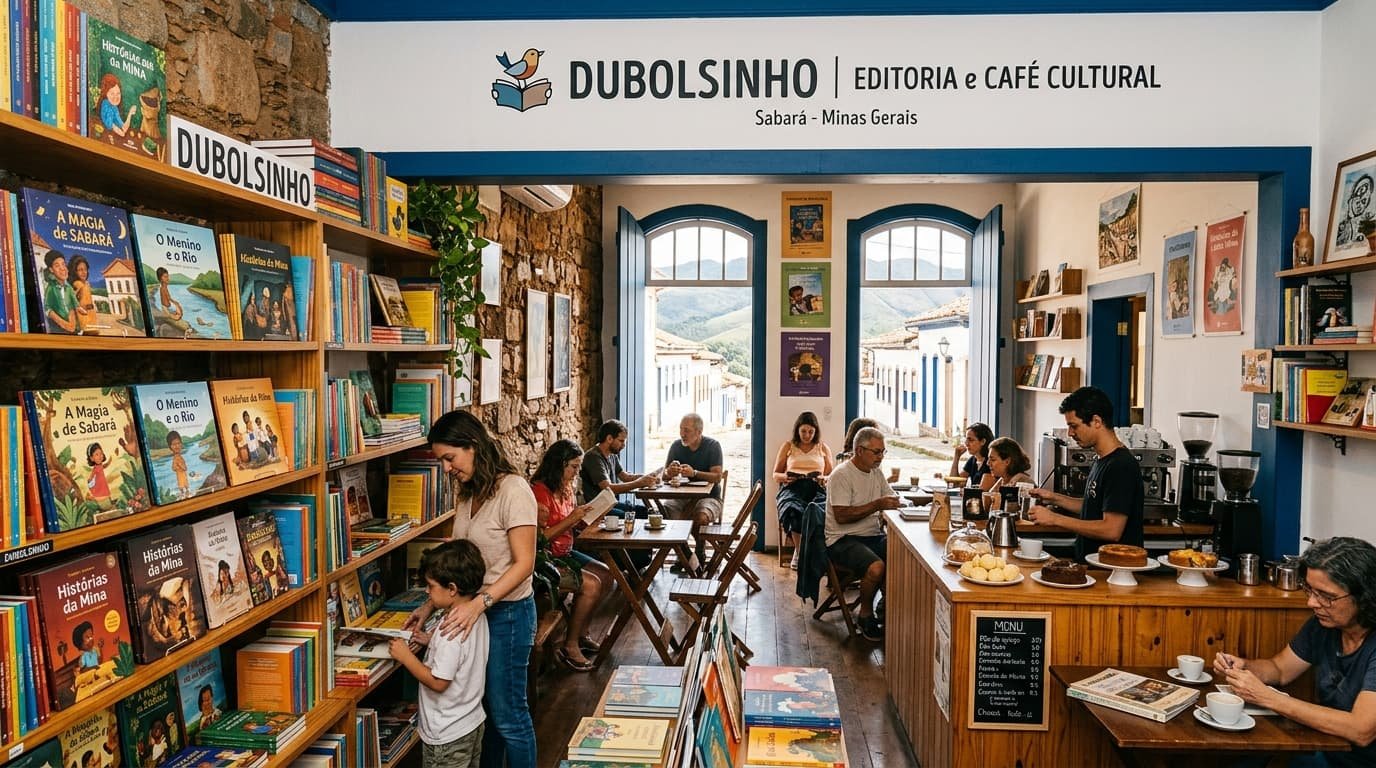
Separate from the publishing house, Café Dubolsinho became a beloved cultural destination in Sabará. It was not simply a place to get coffee; it was a community gathering point where literature, conversation, and creativity came together.
Located in the center of Sabará, Café Dubolsinho positioned itself as a new café, bookshop, and gift store right in front of the Municipal Theatre.
Location in Sabará
The headquarters of Dubolsinho is located in a warehouse in the center of Sabará, a historic city in the metropolitan region of Belo Horizonte, in the state of Minas Gerais.
Sabará itself is a gem, a town rich in colonial architecture, Baroque churches, and a deep cultural identity. Placing a literary café in its center was a natural fit. The proximity to the Municipal Theatre made it a hub for artists, writers, and culture lovers passing through the region.
Atmosphere and Experience at Café Dubolsinho
Café Dubolsinho offered something most cafés simply cannot: the feeling of stepping into a story. The space was designed with books on shelves, locally crafted gifts, and an atmosphere that invited people to slow down and connect.
Visitors described it as warm, unpretentious, and deeply personal. It reflected the same values as the publishing house: independent spirit, cultural pride, and a genuine love for the written word. Whether you came for a coffee, a book, or a gift, you left with a sense of belonging to something meaningful.
Connection Between Books and Coffee Culture
The combination of a café and a publishing house under one identity is rare, and it is what makes Dubolsinho so memorable. In Brazil, coffee is not just a drink; it is a social ritual. Books, similarly, are meant to be shared and discussed.
Dubolsinho represents a fascinating intersection of literature, culture, and community expression, a symbol of educational and literary innovation in Brazil.
By merging these two worlds, Dubolsinho created a space where readers could browse books, sip coffee, and feel part of a larger cultural conversation. It was community-building at its most natural.
Cultural Significance of Dubolsinho
The term Dubolsinho has gained traction in recent years, particularly in Brazilian cultural, literary, and digital contexts. Despite being relatively unknown internationally, it represents a multifaceted concept that spans publishing, artistic expression, and community identity.
Many schools integrated these works into classroom settings, using them as primary teaching materials to support reading comprehension and cultural learning. Libraries across the country included titles in reading programs, encouraging children to engage with stories outside of the classroom.
Dubolsinho proved that independent, community-rooted publishing could make a real difference, not just in literature, but in lives.
Why Dubolsinho Still Stands Out in 2026
Even with the publishing house now closed, Dubolsinho’s reputation has not faded. Here is why it remains a reference point:
- Zero vanity publishing: The publisher never charged authors to publish. Every book was chosen based on quality, not payment.
- Community over commerce: It consistently prioritized social projects and educational impact over profit
- Artistic integrity: Each book was both literarily strong and visually beautiful
- Grassroots model: Built with 40 co-founders sharing a common vision, not corporate backing
- Educational reach: Over 1,700 students touched through the Lerês initiative alone
FAQs
What is Dubolsinho known for?
Dubolsinho is known as a Brazilian independent publishing house specializing in high-quality children’s and young adult literature, and as a cultural café in Sabará, Minas Gerais.
Where is Café Dubolsinho located?
Café Dubolsinho is located in the center of Sabará, Minas Gerais, Brazil, directly in front of the Municipal Theatre.
What type of books does Edições Dubolsinho publish?
Edições Dubolsinho published children’s and young adult books in Brazilian Portuguese, covering fiction, poetry, illustrated stories, and culturally rich narratives.
Are Dubolsinho’s books still available?
While the publishing house closed in 2019, many titles remain available through second-hand bookshops, Brazilian libraries, and online marketplaces.
Why is Dubolsinho important to Brazilian culture?
Dubolsinho filled a critical gap in the market for culturally relevant, high-quality Brazilian children’s literature and ran impactful educational programs that reached over 1,700 school children.
Is Café Dubolsinho still open?
The original Café Dubolsinho underwent changes in management. As per its last social media updates, a new café was set to open under new direction after January 2019.
Who are the famous authors published by Dubolsinho?
Notable authors include Sebastião Nunes (Sebastião Nuvens), Guilherme Mansur, Fernando Brant, Humberto Werneck, and Fernando Alsandálio.
Did Dubolsinho win any awards?
Yes. Founder Sebastião Nunes received the prestigious Prêmio Governo de Minas Gerais de Literatura in 2018 for his lifetime contribution to Brazilian arts and literature.
Conclusion
Dubolsinho is more than a name; it is a story of passion, community, and the enduring power of books. From a humble beginning with six titles co-created by 40 dreamers in Sabará, it grew into a publisher that shaped how thousands of Brazilian children experienced literature. The Café extended that spirit into everyday life, offering a space where stories and coffee could coexist in perfect harmony.
Even in 2026, years after the publishing house closed its doors, Dubolsinho’s influence remains visible in Brazilian classrooms, libraries, and cultural conversations. It stands as proof that independent publishing, when rooted in genuine purpose, can leave a legacy far greater than its size ever suggested.
For anyone interested in Brazilian children’s literature, independent publishing, or the cultural life of Minas Gerais, Dubolsinho is a name worth knowing, remembering, and celebrating.